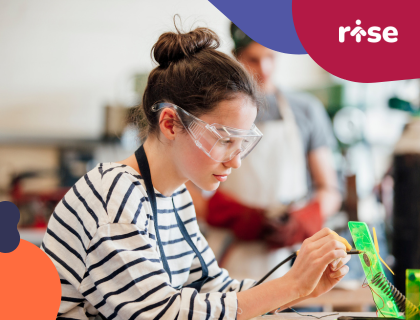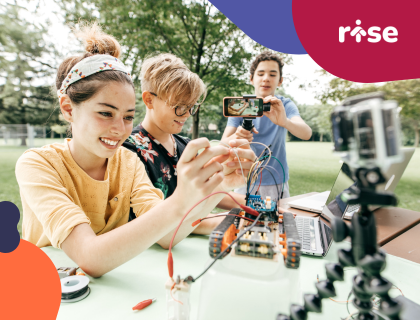
Middle school is a time when students begin asking deeper questions, noticing patterns, and making connections between what they learn in school and how the world works. For many parents, it’s also a time when keeping curiosity alive takes a bit more intention, especially as hands-on exploration becomes less common. That’s where science experiments can make a real difference. When done well, they don’t just feel fun — they help students:
- think critically
- test ideas independently
- build confidence through discovery
Over time, these small experiments can grow into something much bigger — a genuine interest in STEM and the confidence to keep exploring, learning, and trying new ideas. These early experiences often shape how students begin to see themselves — not just as learners, but as thinkers, problem-solvers, and creators.
In this guide, you’ll find simple, engaging science experiments for ages 11–14, along with ideas for how each activity can develop into more meaningful, portfolio-ready projects over time.
Why Science Experiments Are Important
Science experiments give students the chance to move beyond memorizing concepts and start understanding how things actually work. Instead of simply learning what happens, they begin to ask:
- Why does this happen?
- What changes if I adjust one variable?
- What should I test next?
This shift builds essential skills such as:
- problem-solving
- analytical thinking
- persistence through trial and error
Just as importantly, experiments give students something many classrooms can’t always provide: a real sense of ownership over their learning. When they test their own ideas and see the results firsthand, something shifts. They become more engaged, more confident, and more curious about what to explore next. That sense of ownership is often what turns curiosity into something lasting.
Safety Tips for Your Child’s Science Experiments
Before getting started, it’s helpful to create a space where your child can explore safely and confidently. A few simple habits go a long way:
- Supervise experiments that involve heat, chemicals, or sharp tools
- Use protective gear when needed (gloves, goggles)
- Keep the workspace clean and organized
- Follow instructions carefully, and avoid experimenting with unknown materials
The goal isn’t to limit exploration; it’s to create a safe structure that allows your child to experiment, stay curious, and enjoy the process. Think of this as setting the foundation for safe, confident exploration.
Science Experiments by Category
Sometimes the hardest part is just getting started. These experiments are designed to feel approachable and engaging, while giving your child the right level of challenge to build skills.
Chemistry Experiments
Baking Soda and Vinegar Reaction
This is a great first experiment to build confidence and get your child excited about testing their own ideas.
- Materials: Baking soda, vinegar, container, food coloring (optional)
- How it works: Add a few spoonfuls of baking soda into the container, then slowly pour in the vinegar. You’ll see an immediate fizzing reaction as the two combine and release gas.
- Tip: Try changing the amount of baking soda or vinegar each time and notice what happens. Ask your child: Which combination creates the biggest reaction?
- Skills developed: Observation, early hypothesis testing, understanding cause and effect
DIY pH Indicator with Red Cabbage
This is a great way to introduce your child to how scientists test and compare results in a simple, visual way.
- Materials: Red cabbage, water, cups, a few household liquids (lemon juice, soap, baking soda)
- How it works: Chop the red cabbage and soak it in warm water for a few minutes until the water turns purple. Pour the liquid into separate cups, then add different household liquids to each one. Watch how the color changes — this shows whether each substance is acidic or basic.
- Tip: Have your child write down the color for each liquid and create a simple chart. Ask: Which substances changed the color the most?
- Skills developed: Data collection, classification, scientific observation
Physics Experiments
Balloon Rocket
This is a fun way to help your child see how forces and motion work, and how small changes can affect results.
- Materials: Balloon, string, straw, tape
- How it works: Thread a piece of string through the straw and tie it tightly between two points (like two chairs). Inflate the balloon, tape it to the straw, and then let go. As the air rushes out, the balloon moves forward along the string like a rocket.
- Tip: Try changing one thing at a time — like the size of the balloon or the length of the string. Ask your child: Which setup makes the rocket travel the fastest or the farthest?
- Skills developed: Experiment design, testing variables, understanding motion and force
Paper Bridge Challenge
This is a great way to show your child how small design changes can make a big difference, which is a key idea in engineering and real-world problem-solving.
- Materials: Paper, books (for support), coins
- How it works: Place two stacks of books a short distance apart to act as supports. Use a single sheet of paper to create a “bridge” between them. Then slowly add coins on top to see how much weight the bridge can hold before collapsing.
- Tip: Encourage your child to try different designs — folding the paper, layering it, or changing its shape. Ask: Which design holds the most weight, and why do you think it works better?
- Skills developed: Problem-solving, engineering thinking, testing and improving designs
Biology Experiments
Plant Growth Experiment
This is a great way to help your child understand how small changes can impact results — a key idea in both science and everyday problem-solving.
- Materials: Seeds, soil, water, small containers or pots
- How it works: Plant the same type of seed in a few different containers. Change one condition for each plant — for example, place one in sunlight and one in shade, or vary how much water each plant receives. Over time, observe how each plant grows under different conditions.
- Tip: Have your child measure the height of each plant every day or every few days and track the results. Ask: Which condition helped the plant grow the most? Why do you think that is?
- Skills developed: Data tracking, consistency, scientific observation
DIY Lung Model
Sometimes the best way to understand something complex is to see it in action, and this model makes that possible.
- Materials: Plastic bottle, balloons, rubber bands
- How it works: Cut the bottom off a plastic bottle. Place a balloon inside the bottle and stretch the opening over the top to represent the lungs. Then attach another balloon to the bottom of the bottle. When you pull the bottom balloon down, the inside balloon inflates — just like your lungs when you breathe in.
- Tip: Ask your child: What happens when you pull the balloon down? What changes when you push it back up? You can also connect this to real life by talking about how breathing changes during exercise.
- Skills developed: Systems thinking, biological understanding
Earth & Environmental Science
Water Filtration Experiment
This experiment helps students see how science connects to real-world challenges, like access to clean water — and why simple solutions often have limits.
- Materials: Plastic bottle, sand, gravel, charcoal, dirty water
- How it works: Cut the bottom off a plastic bottle and turn it upside down. Layer the materials inside (for example: gravel at the top, then sand, then charcoal). Slowly pour dirty water through the filter and observe how it changes as it passes through each layer.
- Tip: Compare the filtered water with the original. Ask your child: Does it look cleaner? Would it be safe to drink? Why or why not? This is a great opportunity to talk about how real-world water filtration works — and its limitations.
- Skills developed: Environmental awareness, problem-solving, real-world application
Mini Water Cycle Model
This is a simple way to help your child see how natural systems work and how small observations can lead to a bigger understanding.
- Materials: Bowl, plastic wrap, water, sunlight
- How it works: Fill a bowl with a small amount of water and cover it tightly with plastic wrap. Place it in a sunny spot. Over time, you’ll see water evaporate, collect as droplets on the plastic wrap, and then fall back down — creating a mini version of the water cycle.
- Tip: Try placing the setup in different locations (sunlight vs. shade) and observe what changes. Ask your child: Where does the water go, and how does it return?
- Skills developed: Systems thinking, observation, environmental science concepts.
Common Mistakes to Avoid
Most of these are easy to miss in the moment. Knowing what to watch for helps your child get more out of every experiment, not just the ones that go as planned.
- Skipping reflection: It’s easy to move from one experiment to the next, but reflection is where real learning happens. Encourage your child to ask: What did I learn? What would I try differently next time?
- Focusing only on results: It’s not just about whether the experiment “worked.” The process — testing ideas, making adjustments, and learning along the way — is just as important.
- Choosing overly complex experiments too early: Starting simple helps build confidence. As your child gains experience, they’ll naturally be ready to take on more challenging ideas.
- Inconsistent practice: Curiosity grows with consistency. Even small, regular experiments help students build skills, confidence, and momentum over time.
Tips for Parents
Your role is to support your child’s curiosity, not control the process. Small, consistent encouragement can make a big difference over time. Here are a few simple ways to help:
- Encourage questions: Instead of giving answers right away, try asking: “What do you think will happen next?” This helps your child stay curious and think more independently.
- Celebrate effort and exploration: Focus on what your child tried, not just what worked. Recognizing effort helps build confidence and a willingness to keep going.
- Create a simple routine: Even one experiment per week can build strong habits. Over time, these small moments add up and create real progress.
- Give space for independence: Allow your child to take ownership, even if things don’t go perfectly. That’s often where the most meaningful learning happens.
With the right support, these small experiences can help your child build confidence, curiosity, and a lasting interest in learning.
Conclusion
Science experiments don’t need to be complicated to be meaningful. With the right approach, even simple activities can help students build confidence, develop critical thinking skills, and discover what genuinely interests them.
Over time, these small moments of curiosity can lead to something much bigger — deeper exploration, stronger skills, and projects that reflect your child’s growing interests and potential.
Start small. And most importantly, support your child as they explore, experiment, and continue building confidence along the way.
If you think your child is ready to take their curiosity further, Crimson Rise is here to help. Our mentors work with students aged 11–14 to identify what they genuinely care about and build something meaningful from it. Book a free consultation to get started.
FAQ
How often should kids do science experiments?
Even once a week can make a meaningful difference. Consistency matters more than frequency — small, regular experiences help build interest and confidence over time.
Are science experiments safe for middle schoolers?
Yes, with proper supervision and a few basic safety precautions. Creating a safe, structured environment allows students to explore with confidence.
Do science experiments help with school performance?
Yes, they help students better understand concepts, strengthen problem-solving skills, and build confidence in STEM subjects over time.

.png)
.png)