%20(7).png)
Middle school is one of the most pivotal academic transitions your child will face. Most families don't realize it until grades are already slipping.
The challenge with falling behind isn't just the grades themselves. Catching up requires significantly more effort than staying on track would have in the first place.
Yet, the difference between students who thrive and those who struggle rarely comes down to intelligence. It comes down to habits. The right study strategies, built early, do more than improve grades. They cultivate the academic confidence that sets your child up for high school, college applications, and long-term success.
Why Middle Schoolers Struggle to Get Good Grades
The jump from elementary to middle school is steeper than most families expect. More teachers, more subjects, higher stakes, and significantly less structure, all hitting at once. Understanding why students struggle is the first step toward helping them thrive. Here are the most common reasons grades slip during this critical window.
Their Old Study Habits No Longer Work
Most students enter middle school using the same approach that worked in elementary school, and are genuinely surprised when it stops working. Without anyone showing them how to study differently, grades become inconsistent despite real effort. Over time, that gap between trying hard and not seeing results quietly undermines your child's confidence in ways that are difficult to reverse.
Time Management Skills Don't Come Naturally
In elementary school, teachers structured every moment of the day, from subject transitions to deadline reminders. Middle school removes that scaffolding entirely. Students are now expected to independently track due dates across multiple teachers, pace their studying ahead of tests, and balance academics alongside extracurriculars. Without the right guidance, work accumulates, studying gets pushed to the last minute, and last-minute cramming rarely produces the results students are hoping for.
Motivation Starts to Waver
When grades slip, motivation usually follows. It's a pattern that starts quietly and builds quickly. Watch for these signs:
- A consistently negative or dismissive attitude toward school
- Dropping grades in subjects your child once excelled in
- Pulling away from extracurriculars they previously loved
Left unaddressed, these patterns tend to compound, making it increasingly difficult for your child to get back on track the longer it goes on.
Lack of Study Space and Routine at Home
To your child, homework isn't just schoolwork. It's time taken away from friends, hobbies, and rest. Without a dedicated study space, clear expectations around screen time, and a predictable daily rhythm, even a motivated student will struggle to build consistent habits. If your child doesn't know what to expect when they get home each day, maintaining any consistent study routine becomes genuinely difficult to sustain.
The good news is that every one of these challenges is addressable. Here are the study habits that make the biggest difference.
Study Habits That Help Middle Schoolers Get Good Grades
Good grades in middle school don't come from studying harder. They come from studying smarter. These are the core habits that consistently separate students who improve from those who stay stuck.
Build a Daily Study Routine and Stick to It
The most effective student habit isn't about how long your child studies. It's about consistency. Students who get good grades in middle school come home each day knowing exactly what's due, how long it will take, and when they're going to do it. They write assignments down in a planner, set a regular study time, and follow through without needing reminders. That kind of predictable routine removes the daily negotiation around homework and replaces it with a habit that becomes second nature.
Stay Organized Across Every Subject
Middle school means managing paperwork, handouts, and assignments across six or more subjects at once. Students who keep up are the ones with clear systems: a structured backpack with dedicated folders for each class, a consistent spot for completed versus pending work, and a habit of breaking bigger assignments into smaller steps they can act on daily. Organization isn't just tidiness. It's what prevents deadlines from being missed and assignments from being forgotten.
Follow a Time Management System
One of the most underrated study habits is simply knowing where your time is going. Many students feel busy without actually making progress. A simple activity log helps fix that by mapping out when each subject gets attention, how long to spend on it, and where the week's study time actually fits alongside extracurriculars and downtime.
Here's an example of how your child can plan their week to stay on top of their workload without feeling overwhelmed midweek.
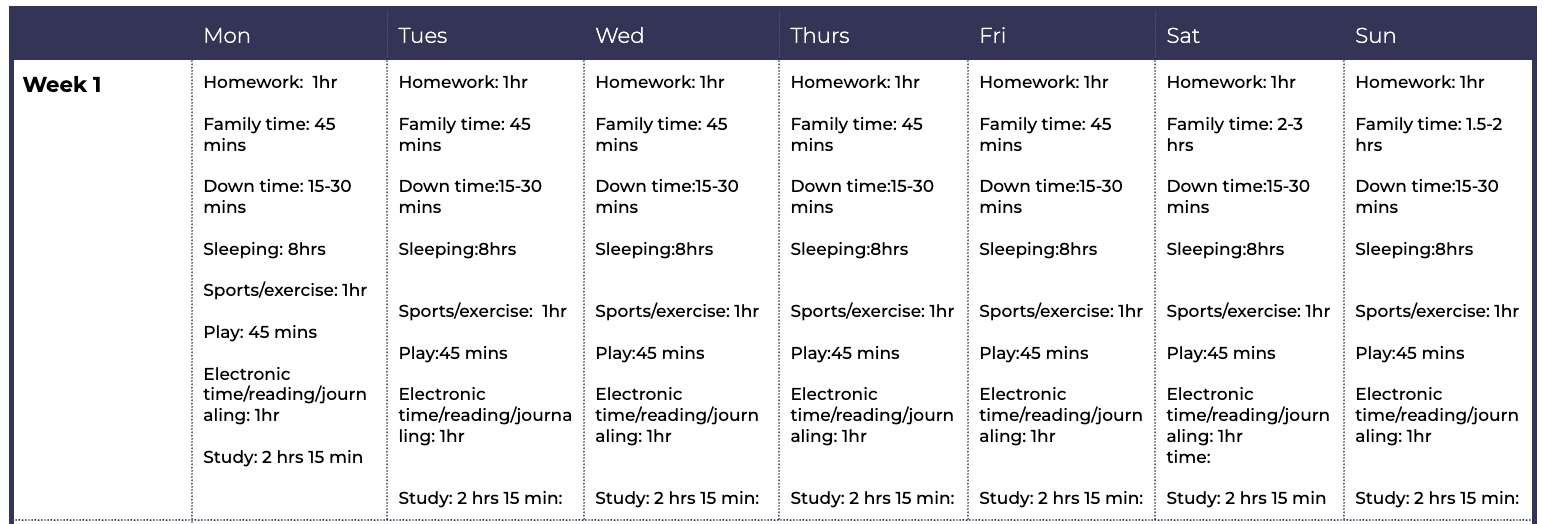
Notice how the tracker separates study time from family time, physical activity, screen time, and downtime. Each category has a dedicated slot so study time has a fixed place in the week rather than getting squeezed out by everything else.
Follow the Pomodoro Technique
Instead of sitting down to study for hours at a stretch, the Pomodoro Technique breaks study time into short, focused bursts. It's simple to follow and surprisingly effective, even for students who struggle to concentrate. A 2024 study published in Advances in Computational Intelligence (Dianita et al., Springer) confirmed that regular micro-breaks during cognitive work help stabilize performance and reduce the mental fatigue that builds up during continuous study.
Here's how it works:
- Focus for 25 minutes. Pick one task and give it full attention. Phone away, distractions off.
- Take a 5-minute break. Stand up, stretch, get a glass of water. Let the brain reset.
- Repeat. After four rounds, take a longer break of 15 to 30 minutes before starting again.
The structure removes the overwhelm of open-ended study sessions and trains your child to associate sitting down at their desk with focused, purposeful work. Over time, that association becomes a habit.
Aim for Progress, Not Perfection
One of the most damaging mindsets in middle school is the belief that anything less than straight A's means failure. Students who improve most consistently are the ones who learn to treat incremental progress as a real win.
Raising a C to a B matters. It builds momentum, reinforces effort, and develops what researchers call a "growth mindset." A study of over 12,000 students published in Nature found that students who believed their abilities could grow through effort earned higher grades and took on more challenging coursework than peers who didn't share that belief (Yeager et al., 2019).
A simple way to encourage this at home is during report card reviews. Instead of focusing on what went wrong, ask your child: "What grade would you like to aim for next quarter?" That one question shifts the conversation from judgment to ownership, and ownership is where improvement begins.
How Parents Can Support Strong Study Habits
While getting good grades in middle school is ultimately your child's responsibility, the environment and support you provide at home make a significant difference. Here's how to set them up for success.
Provide Structure and a Supportive Study Environment
A structured household with consistent mealtimes, predictable routines, and regular family activities does more for your child's study habits than it might seem. When structure is already a normal part of daily life, adopting new academic habits becomes much easier.
A practical starting point is investing in a dedicated study desk and chair for your child's room. Better yet, take them shopping for it. Letting your child choose their own setup builds a sense of ownership, and it gives you a natural opportunity to set clear expectations: this space is for focused work, and breaks happen somewhere else.
Guide Without Micromanaging
Once the structure is in place, your role shifts to staying engaged without hovering. Checking in on your child's progress is healthy; managing every step of it is counterproductive. Micromanaging gets in the way of the independence and self-confidence your child needs to develop at this stage.
Positive parental guidance looks more like:
- Praising effort and progress, not just results
- Bringing in outside help, like a tutor, when needed
- Keeping communication open and judgment-free
That last point matters most. When your child feels comfortable telling you they're struggling, you can actually do something about it.
Help Your Child Develop and Maintain Routines
Building strong routines starts at home, and the best way to teach them is through practice and modeling. A few simple ways to get started:
- Have your child set their own alarm instead of relying on you. Once they've got it down on weekdays, extend it to weekends too.
- Model your own routines openly. When your child sees you consistently paying bills, exercising, or keeping up with household tasks, routine starts to feel like a normal part of life rather than something imposed on them.
- Give your child a regular household responsibility at a set time each week. Middle school is the right age to start taking on more, and small commitments build the habit of following through.
When to Consider Extra Academic Support
Even with the best foundations in place, some students need more targeted support to get their grades on track. While it's tempting to step in and tutor your child yourself, knowing the material and knowing how to teach it are two very different things.
Look for tutors who are current or former educators, either through local tutoring centers that vet their professionals, or through referrals from your child's teachers. A good tutor doesn't just fill knowledge gaps, they build the kind of trust and rapport that makes your child more receptive to learning and more willing to ask for help when they need it.
If you're looking for something beyond one-on-one tutoring, Crimson Rise is a structured enrichment program for high-potential students aged 11 to 14. We help students build the skills and confidence to achieve consistent results, from middle school all the way through high school. Book a free consultation call to find out if Rise is the right fit for your child.
FAQ
Does tutoring help middle school grades?
Yes. Research from Harvard Graduate School of Education shows that consistent, quality tutoring can produce meaningful academic gains. But beyond filling knowledge gaps, the best tutors also build trust, and a child who trusts their tutor is far more open to learning and asking for help.
How many hours should a middle schooler study?
It depends on your child. Key factors include their weekly workload, the subjects they find most challenging, and any learning differences that affect how they process information. A good starting point is 1 to 2 hours per school night, but talking with your child directly often reveals the most about what's actually slowing them down.
How involved should parents be?
Involved enough to stay informed, but hands-off enough to let your child develop independence. As middle school progresses, your child should gradually need less direct support. The goal is to be approachable enough that they come to you when they do need help, and confident enough to step back when they don't.

%20(8).png)
%20(7).png)
%20(8).png)